
Financial Forecasting for Startups: Tools and Strategies for Predicting Growth
Explore essential tools, strategies, and expert insights on financial forecasting for startups. Learn how to predict growth and engage...
5 min read
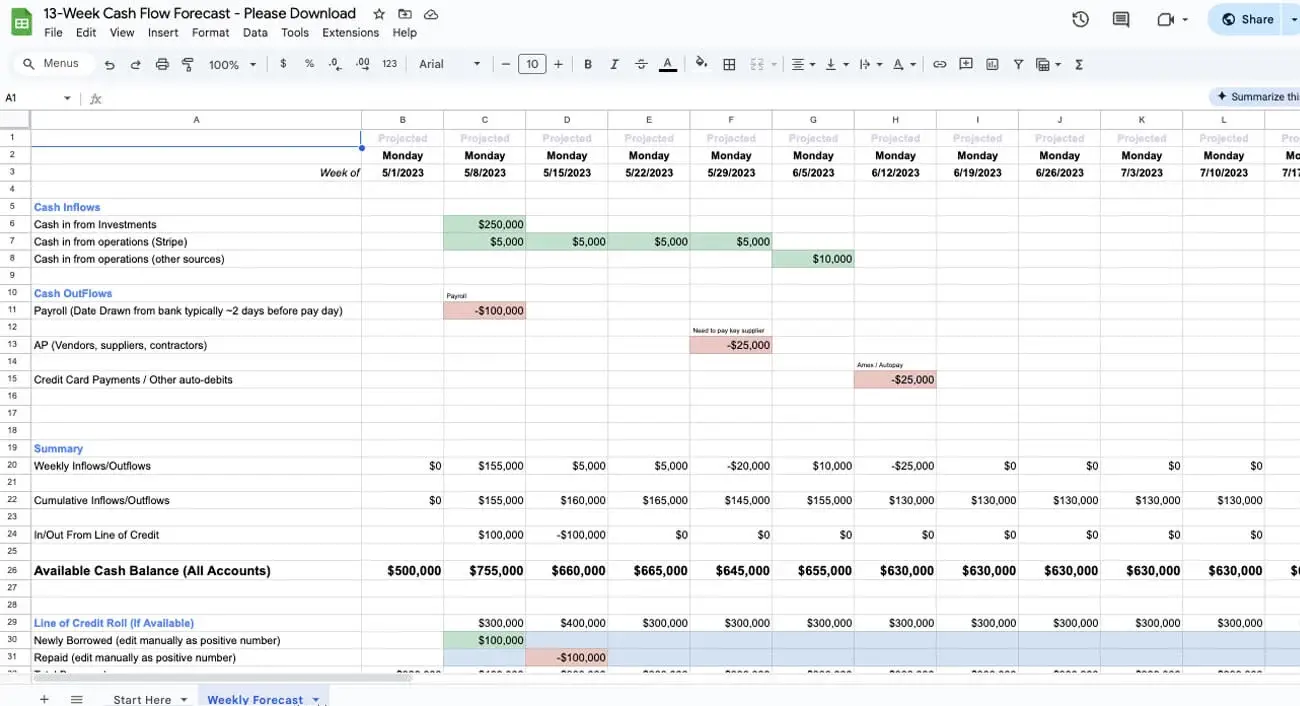
A company can have strong sales, signed contracts, and an approaching funding round—and still run short of cash before the next payroll. The question is not only how much money is coming in. It is when that money will reach the bank account, and what must be paid before it does.A 13-week cash flow forecast puts those dates on a weekly schedule. It starts with available cash, estimates the money expected to come in and go out each week, and calculates the projected ending balance. Updated regularly, it shows where cash could get tight early enough for your team to act.
If you want to build one as you read, start with Graphite’s free 13-week cash flow forecast template.
The calculation for each week is straightforward:
Starting cash + cash received − cash paid = ending cash
That ending balance becomes the following week’s starting balance. Repeat the calculation across 13 weeks, and you have a view of how your cash position may change over roughly a quarter.
The forecast follows cash movement, not the date a sale or expense appears in your accounting records. If you invoice a customer in week one but expect payment in week four, the receipt belongs in week four. If a credit card charge occurs today but the card bill is paid next month, forecast the cash payment when the bill is due. This receipts-and-disbursements approach is one of the short-term forecasting methods described by the Association for Financial Professionals.
Here is a simplified three-week example:
| Week 1 | Week 2 | Week 3 | |
|---|---|---|---|
| Starting cash | $120,000 | $105,000 | $71,000 |
| Customer payments received | $35,000 | $18,000 | $52,000 |
| Cash paid | ($50,000) | ($52,000) | ($45,000) |
| Ending cash | $105,000 | $71,000 | $78,000 |
At first glance, week three looks comfortable. But suppose a $40,000 customer payment included in that week’s receipts slips to week four. Week three’s projected ending cash falls to $38,000. That change could affect a hiring decision, an inventory purchase, or the amount of room available before payroll.
The value of the forecast is the warning. It gives you time to confirm the payment date, adjust spending, arrange financing, or make another deliberate decision.


You can build a first version in a spreadsheet. The hard part is usually not the formula; it is getting realistic dates and amounts from the people who know when cash will move.
Enter the current balances of the bank accounts included in the forecast. Be clear about whether any cash is restricted, held for a specific purpose, or otherwise unavailable for ordinary payments. Reconcile the opening balance to your bank information so the forecast starts from a dependable number.
Include customer collections, subscription payments, financing proceeds, tax refunds, or other expected deposits where relevant. For receivables, use realistic collection dates rather than assuming that every invoice will be paid on its due date.
Separate receipts you can confirm from those that depend on an uncertain event. A signed customer contract is useful context, but it does not tell you the exact week cash will arrive.
Common categories include payroll, benefits, taxes, rent, software, contractors, loan payments, inventory, and planned capital purchases. Use the expected payment week, including large or irregular obligations that can disappear in a monthly average.
Get input from the teams that control those commitments. Accounting may know the payment schedule; Sales may have a better view of a customer collection; Operations may know when a purchase must happen.
For every week, add receipts to starting cash and subtract payments. Carry the ending balance into the next week. Check the lowest projected balance, not only the balance at the end of week 13. A shortfall in week five still matters even if a large payment is expected in week six.
Ask what happens if a major customer pays two weeks late, a hiring plan begins earlier than expected, or inventory must be purchased before the related revenue arrives. You do not need dozens of elaborate scenarios. Start with the few changes that would materially affect the lowest cash balance.
At the end of each week, enter what actually came in and went out. Investigate the meaningful differences, update the remaining weeks, and add a new week at the far end. That keeps the forecast looking 13 weeks ahead instead of becoming a document that was accurate only when it was created.
A 13-week forecast works best as a living tool. SCORE’s cash flow management guidance describes a rolling forecast as a way to spot cash problems early enough to make decisions about spending, hiring, and growth.

A 13-week forecast helps answer questions that an annual budget or month-end report may miss:
That last question makes the forecast better over time. A useful weekly review does more than replace old numbers: it identifies why they were wrong and who can improve the next estimate.
A 13-week cash flow forecast is especially useful when cash timing is consequential: a company is growing quickly, burning cash, carrying significant inventory, relying on a few large customers, approaching a funding milestone, or managing uneven collections.
It can also help a business that appears healthy on a profit-and-loss statement but has little room between incoming payments and outgoing commitments. Revenue and profit describe important parts of performance; they do not guarantee that cash will be available on a particular Friday.
You do not need to wait for a crisis to build the forecast. Establishing the weekly process while cash is stable makes it easier to use when circumstances change.

This is a near-term cash management tool. It does not replace a longer-term financial model for hiring plans, growth scenarios, capital needs, or fundraising strategy. Nor does a projected ending balance guarantee that every customer will pay on the date assumed.
The two views work together. A longer-term model helps leadership decide where the business is going. The weekly cash forecast tests whether the company can meet the commitments along the way. When plans change, update both.
A good 13-week forecast does not have to predict every payment perfectly. It has to show the assumptions behind your cash position, expose the weeks with the least room for error, and help your team respond as new information arrives.
Download Graphite’s free 13-week cash flow forecast template to build your first version. If your company needs help connecting the weekly cash picture to a broader financial plan, explore Graphite’s Finance and FP&A services.

Review it at least weekly. Replace the completed week’s estimates with actual cash movements, revise future payment dates and amounts, and add a new week to maintain the 13-week view. A business under immediate cash pressure may need to review its position more often.
A cash flow statement reports cash movements that have already occurred over a past period. A 13-week forecast estimates future receipts, payments, and balances week by week. Actual cash flow is one of the inputs you use to improve the forecast.
Forecast the expected payment date. An invoice may support your estimate, but sending it does not put cash in the bank. Review collection assumptions as you learn more about each customer’s payment timing.
No. It can help a healthy, growing company plan around payroll, customer collections, inventory purchases, and other uneven cash movements. Its usefulness depends on how much weekly timing affects the decisions your team needs to make.

Explore essential tools, strategies, and expert insights on financial forecasting for startups. Learn how to predict growth and engage...

Unlock financial success with our comprehensive guide to financial projections for startups. Learn essential tips and strategies to manage your...

Failure to comply with GAAP can lead to regulatory issues and long-term problems. If you’re not prioritizing GAAP compliance, now is the time.