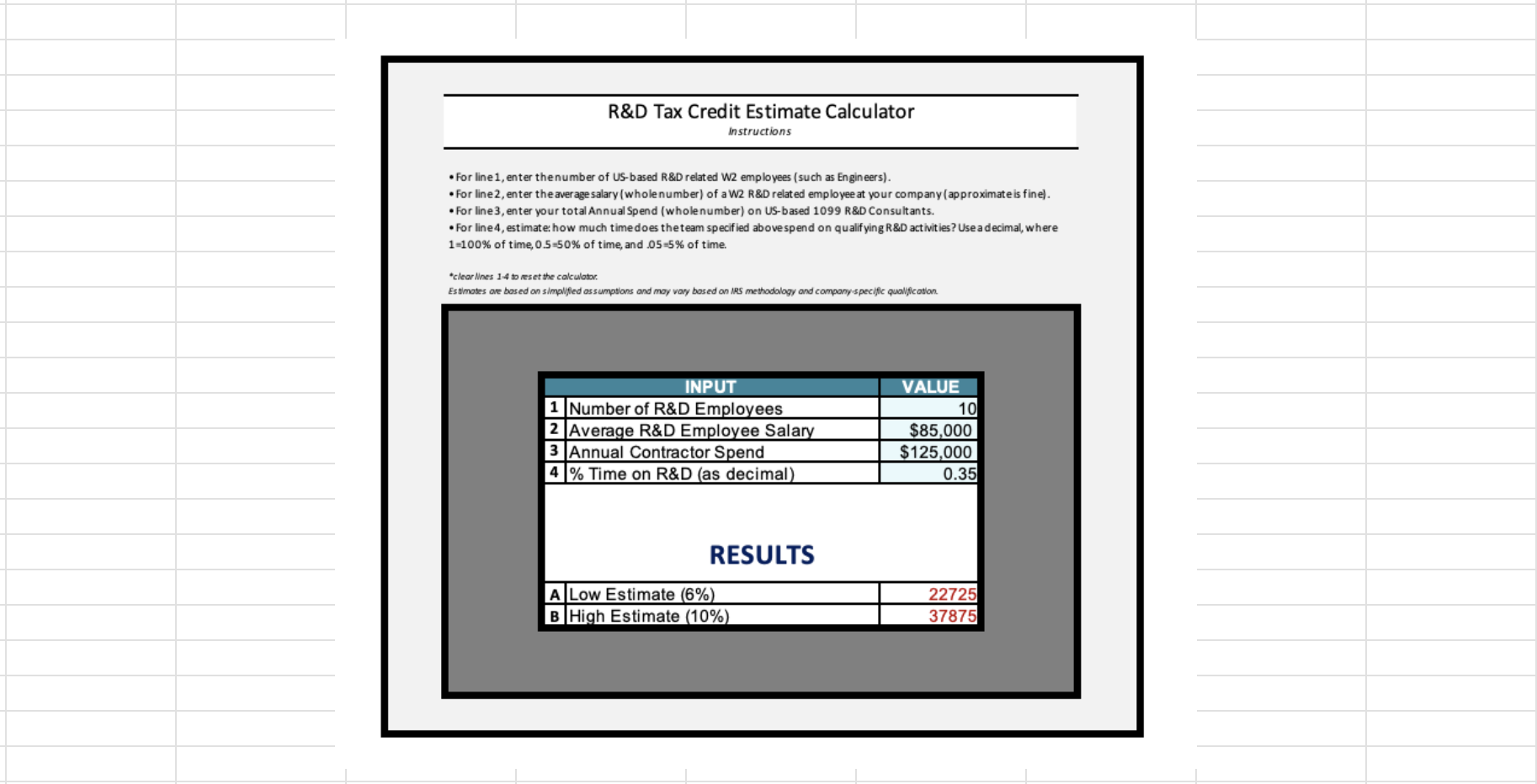
A quick calculator built to help startups estimate potential R&D tax credits before leaving money on the table. Download the template to quantify the opportunity, pressure-test eligibility, and decide whether it’s worth pursuing. Estimate the R&D payroll tax credit (up to $500,000/year) your company is eligible for!
Trusted by 400+ growing teams.
R&D Tax Credit – Qualifying Activities
This four-part test will help you determine if a project is considered R&D. Companies that consider their activities to be business as usual may actually find themselves innovative once they look at the four-part test.
Qualified purpose The purpose of the research must be to create a new or improved business component, resulting in a new or improved function, performance, reliability, or quality. A business component can be a product, process, computer software, technique, formula, or invention—a broad definition that applies to many different industries.
Elimination of uncertainty A company must demonstrate it has attempted to eliminate uncertainty about the development or improvement of a business component. Uncertainty exists if the information available to the company doesn’t establish the capability or method for developing or improving the business component, or the appropriate design of the business component. Many companies are confident in their ability to achieve technical objectives or have an established method for finding solutions, but the design is seldom established at the project’s onset.
Process of experimentation A company must demonstrate—through modeling, simulation, systematic trial and error, or other methods—that it has evaluated one or more alternatives for achieving the desired result. Some activities naturally follow an iterative trial and error process. For example, engineering, software development, or clinical research activities all rely on a process that can evaluate one or more alternatives. The definition is also broad enough to apply to many other types of activities.
Technological in nature The process of experimentation must rely on the hard sciences, such as engineering, physics, chemistry, biology, or computer science. It’s important to note companies aren’t required to exceed, expand or refine existing scientific principles.